Backup Power: A Buyer's Guide to Portable Power Stations
When the power goes out, the difference between an inconvenience and a real problem often comes down to what you already have on hand. A portable power station won't prevent a storm or an ice-covered power line — but it can keep your phone charged, your medical equipment running, and your household connected until the lights come back on.
Last updated: October 6, 2026
In our 72-Hour Emergency Checklist, we listed backup power as one of the essentials every Canadian household should have ready — and promised a closer look at how to choose it. This is that guide.
Affiliate disclosure: WholeSelfEdge participates in the Amazon.ca Associates Program. As an Amazon Associate, we earn from qualifying purchases. Some links in this guide are affiliate links: if you buy through them, we may earn a commission at no additional cost to you. This doesn't change which products we include or what we say about them. Details in our Terms & Affiliate Disclosure.
How We Chose These
This guide is built from three types of information, kept clearly separate: manufacturer specifications (capacity, output, battery chemistry, cycle life, operating temperatures), taken from each brand's own product pages and manuals; independent professional testing, where available, from outlets that measure usable capacity and recharge times themselves (cited by name below); and our own analysis of what each unit can realistically run during a Canadian winter outage. We don't reproduce Amazon prices or customer ratings on this page, because both change constantly; each product link takes you to the current listing on Amazon.ca.
How to read the price tiers: instead of listing prices that change often, we group units by relative cost within this guide: $ (lowest), $$ (mid-range), and $$$ (highest). The three levels below follow the same tiers. Check the current price on Amazon.ca before buying.
Level 1: Essentials ($)
This tier covers phones, lanterns, radios, and small medical devices — not major appliances. It's the right starting point if your main concern is staying connected and having light during a multi-day outage.
Top Pick — EcoFlow RIVER 2 240
Capacity: 243 Wh
Output: 300 W continuous (600 W surge)
Battery: LiFePO4, rated for 80%+ capacity after 3,000 cycles
Recharge: 0–100% in about 60 minutes from a wall outlet; up to 110 W solar input
Cold weather: charges from 0 °C to 45 °C; can be used down to −10 °C
Backup switching: automatic switchover in under 30 ms
Weight: about 3.5 kg (7.7 lb)
(Specs above are manufacturer claims, from EcoFlow Canada.)
Price tier: $ · Check the current price on Amazon.ca
Independent testing: we didn't find a published lab test of this exact model yet.
Why: the lowest-cost capable option in this tier, covering the core use case — phones, small lights, a router — well, with a fast one-hour wall recharge.
Alternatives
Capacity: 288 Wh
Output: 600 W continuous (up to 1,500 W in BLUETTI's “power lifting” mode, for resistive loads only)
Battery: LiFePO4, rated for over 3,000 cycles to 80%
Recharge: 80% in about 45 minutes from a wall outlet; up to 200 W solar input
Cold weather: charges from 0 °C to 40 °C; can be used down to −20 °C
Backup switching: UPS switchover of 10 ms or less
Warranty: 5 years
(Specs above are manufacturer claims, from BLUETTI's product page and user manual.)
Price tier: $ · Check the current price on Amazon.ca
Independent testing: we didn't find published measured results for this model yet.
Capacity: 293 Wh
Output: 300 W
Battery: lithium-ion (not LiFePO4), rated for 800 cycles to 80%
Recharge: about 2.5 hours using wall and USB-C charging together
Warranty: 2 years plus a 1-year extension
(Specs above are manufacturer claims, from Jackery Canada.)
Availability note: Jackery's Canadian store listed this model as sold out when we checked on September 29, 2026.
Price tier: $ · Check the current price on Amazon.ca
Independent testing: OutdoorGearLab gave it its Best Buy award for phones and laptops (52/100). In its tests the unit delivered 260 Wh, 89% of its rated capacity, and took about 4 hours to recharge.
Level 2: Standard Home Backup ($$) — Our Primary Recommendation Range
This is the range we'd point most Canadian households to first: enough capacity to run a router, charge multiple devices repeatedly, power a CPAP machine overnight, or briefly run a mini-fridge or a small heater, without the cost or bulk of the largest units.
Top Pick — EcoFlow Delta 2
Capacity: 1,024 Wh
Output: 1,800 W continuous (2,700 W surge)
Battery: LiFePO4, rated for 3,000 cycles to 80%+
Recharge: about 1.2 hours from a wall outlet; up to 500 W solar input
Cold weather: charges from 0 °C to 45 °C; can be used down to −10 °C
Backup switching: within 30 ms
Warranty: 5 years
(Specs above are manufacturer claims, from EcoFlow Canada and the DELTA 2 user manual.)
Price tier: $$ · Check the current price on Amazon.ca
Independent testing: named “Best Overall” for 2026 by Outdoor Life, which found it a “stronger performer in all testing categories.” In its tests the unit delivered 88% of its rated capacity at a 380 W draw but only 67% at a very low 34 W draw, and recharged in 1 hour 15 minutes.
Alternatives
Capacity: 1,070 Wh
Output: 1,500 W
Battery: LiFePO4, rated for 4,000 cycles to 70%+ (Jackery measures to 70%, while most brands here quote cycles to 80%)
Recharge: 1 hour in emergency charging mode, 1.6 hours standard, from a wall outlet
Cold weather: charges from 0 °C to 45 °C; can be used down to −10 °C
Backup switching: under 20 ms
Warranty: 3 years (Jackery adds 2 extended years for purchases on its own website)
(Specs above are manufacturer claims, from Jackery.)
Price tier: $$ · Check the current price on Amazon.ca
Independent testing: OutdoorGearLab scored it 67/100; in its tests it delivered 910 Wh (85% of rated capacity) and recharged in about 1.6 hours.
Capacity: 1,024 Wh
Output: 2,000 W (3,000 W peak)
Battery: LiFePO4, rated for at least 80% capacity after 4,000 cycles
Recharge: 49 minutes from a wall outlet at 1,600 W; up to 600 W solar input
Cold weather: charges from 0 °C to 40 °C; can be used down to −20 °C
Backup switching: 10 ms
(Specs above are manufacturer claims, from Anker SOLIX Canada.)
Price tier: $$ · Check the current price on Amazon.ca
Independent testing: “Best Overall” — GearJunkie. “Best for Solar Generators” — Outdoor Life, which measured 90% of rated capacity at a 380 W draw and a 47-minute recharge. “Best Value for Most People” — OutdoorGearLab (70/100), which measured 890 Wh (80% of rated capacity) and a recharge of under an hour.
Level 3: Extended / High-Capacity ($$$)
This tier is for longer outages, larger households, or anyone who wants to keep a refrigerator or a small space heater running for an extended period.
Top Pick — EcoFlow Delta 2 Max
Capacity: 2,048 Wh — roughly double our Level 2 pick
Output: 2,400 W continuous (4,800 W surge)
Battery: LiFePO4, rated for 3,000 cycles to 80%+
Recharge: about 80 minutes from a wall outlet; up to 1,000 W solar input
Cold weather: charges from 0 °C to 45 °C; can be used down to −10 °C
Warranty: 5 years
(Specs above are manufacturer claims, from EcoFlow Canada and the DELTA 2 Max user manual.)
Price tier: $$$ · Check the current price on Amazon.ca
Independent testing: StorageReview measured 1,800 Wh usable through the AC outlets at a 350 W load (about 88% of rated capacity) in its 2023 review. Not to be confused with the older EcoFlow DELTA Max 2000, which was recalled in 2025 (see “What to Look For”).
Alternatives
Capacity: 2,042 Wh
Output: 2,200 W
Battery: LiFePO4, rated for 4,000 cycles to 70%+
Recharge: about 1.75 hours from a wall outlet; up to 400 W solar input
Cold weather: charges from 0 °C to 45 °C; can be used down to −10 °C
Backup switching: under 20 ms
(Specs above are manufacturer claims, from Jackery.)
Price tier: $$$ · Check the current price on Amazon.ca
Independent testing: OutdoorGearLab's Editors' Choice for off-grid camping (81/100, its highest score among the units in this guide); in its tests it delivered 1,710 Wh (84% of rated capacity) and recharged in about 2.5 hours.
Capacity: 3,014.4 Wh
Output: 2,400 W (up to 4,800 W in “power lifting” mode, for resistive loads only)
Battery: LiFePO4
Recharge: 100% in about 2.8 hours from a wall outlet (standard mode); up to 1,200 W solar input
Cold weather: charges from 0 °C to 40 °C; can be used down to −20 °C
Backup switching: 10 ms
(Specs above are manufacturer claims, from the BLUETTI Elite 300 user manual.)
Price tier: $$$ · Check the current price on Amazon.ca
Independent testing: StorageReview (August 2026) measured 2.67 kWh usable (about 89% of rated capacity) and an 8 ms switchover to battery power.
What Can You Actually Run During a Winter Power Outage?
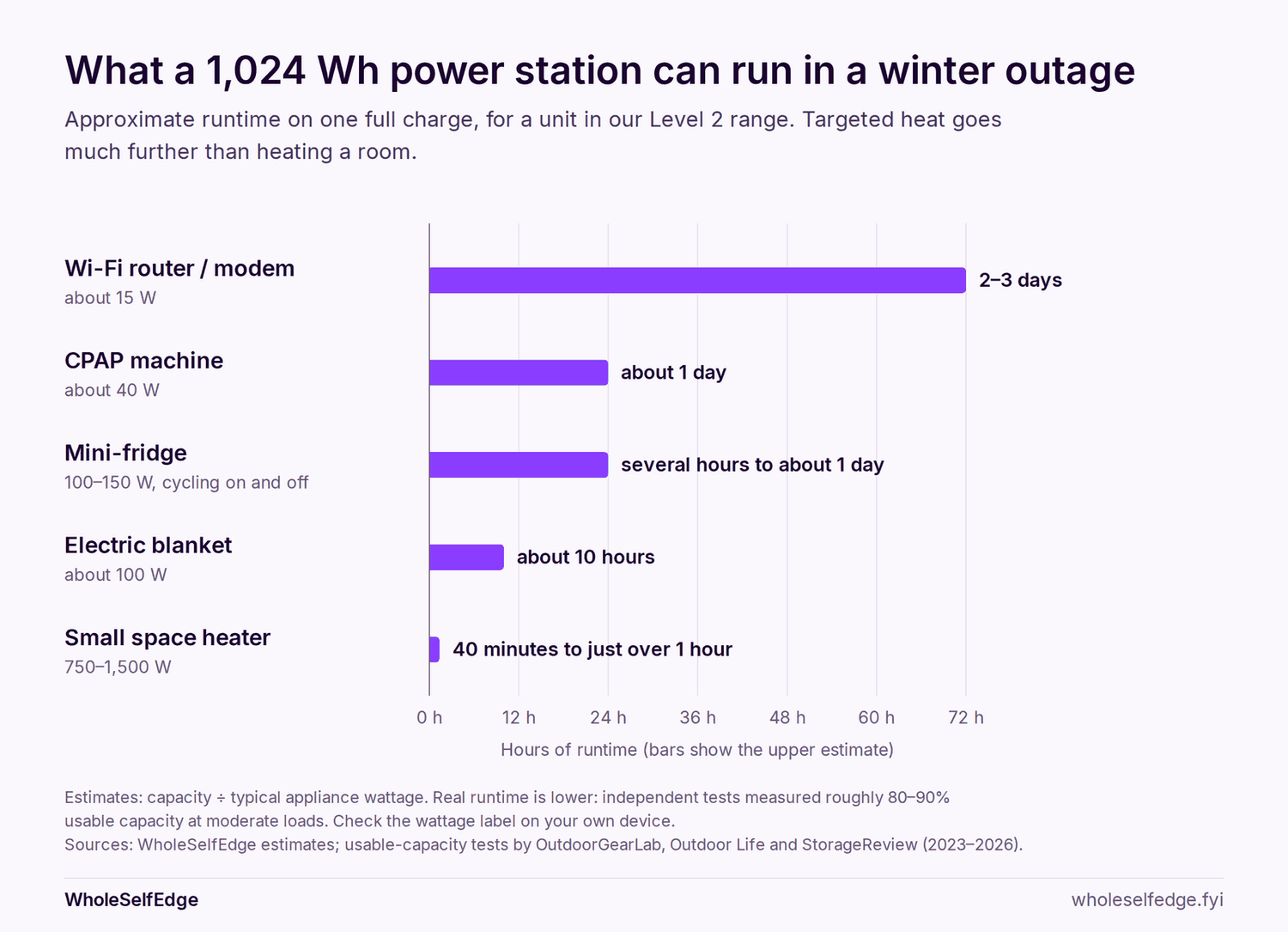
Capacity (Wh) and appliance draw (W) determine runtime: usable capacity ÷ draw = roughly how many hours you get. Usable capacity is less than the label, because of inverter and other losses: independent tests measured roughly 80–90% at moderate loads and less at very small loads. Using a Level 2 unit (around 1,024 Wh) as a reference point, with those losses already subtracted:
Phone charging: dozens of full charges.
Wi-Fi router/modem (~15 W): about 2 days of continuous power.
CPAP machine (about 8–20 W without the heated humidifier, 21–50 W with it, based on ResMed's published figures for the AirSense 10): roughly 4–13 nights without the humidifier, or 2–5 nights with it. Ask your equipment provider which battery or DC cable is approved for your machine.
Mini-fridge (~100–150 W, cycling on and off): several hours of continuous draw, often stretching to a full day since the compressor doesn't run constantly.
Small ceramic space heater (750–1,500 W, depending on setting): this is the one to plan around carefully. A 1,024 Wh unit only delivers roughly 40 minutes to just over an hour of heater use before it's drained. A Level 3 unit (~2,048 Wh) roughly doubles that, to 1–2.5 hours.
Electric blanket or heated throw (~100 W): a much more efficient way to stay warm from a limited battery — a Level 2 unit can run one for roughly 9 hours, compared to about an hour or less for a space heater.
These are estimates based on typical appliance wattages, not a specific model's tested performance — check the wattage label on your own device, since it varies. The practical takeaway: if staying warm is the priority and your power station is capacity-limited, targeted heating (an electric blanket, a heated seat cushion) will get you much further than trying to heat a room. For the same devices on a smaller (about 256 Wh) and a larger (about 2,048 Wh) unit, see the next section.
What Each Size Can Run: 256 Wh vs 1,024 Wh vs 2,048 Wh
The three sizes most buyers compare are around 256 Wh (Level 1), 1,024 Wh (Level 2) and 2,048 Wh (Level 3). The table shows how long each one can run the same devices. These are our estimates, already reduced for losses: we assume 65–85% of the rated capacity is usable for small loads under about 50 W, and 85–90% for larger loads, in line with the independent test results cited in this guide.
| Device (draw we used) | About 256 Wh | About 1,024 Wh | About 2,048 Wh |
|---|---|---|---|
| Wi-Fi router/modem (~15 W) | 11–14 hours | About 2 days | About 4 days |
| LED bulb, 60 W equivalent (~9 W) | 18–24 hours | 3–4 days | 6–8 days |
| Laptop (~50 W while in use) | About 4 hours | 15–17 hours | 31–35 hours |
| CPAP, no humidifier (8–20 W, 8-hour night) | 1–3 nights | 4–13 nights | 8–26 nights |
| CPAP with heated humidifier (21–50 W, 8-hour night) | Under 1 night to about 1 | 2–5 nights | 3–10 nights |
| Full-size fridge (about 1.0–1.1 kWh a day) | Not recommended: about 5 hours at best, and it may not start | About 1 day | 1.5–2 days |
| Electric blanket (~100 W) | About 2 hours | About 9 hours | 17–18 hours |
| Sump pump, 1/3 HP (~1,100 W while running) | Cannot run it: above the 300–600 W output of the Level 1 units in this guide | About 45–50 minutes of total pumping | About 1.5 hours of total pumping |
| Space heater (750–1,500 W) | Cannot run it: above the 300–600 W output of the Level 1 units in this guide | 35–75 minutes | 70–150 minutes |
Where the wattages come from: LED bulb, U.S. FTC; laptop and space heater, Virginia Cooperative Extension; CPAP, ResMed battery guide (AirSense 10 current draw at 12 V: 0.70–1.66 A without humidifier, 1.73–4.19 A at humidifier setting 4); fridge, U.S. Department of Energy (about 364–404 kWh a year for a standard refrigerator-freezer). Sump pump, a 1/3 HP example rated 9.7 A at 115 V (Zoeller M53 specifications); a pump needs extra power to start, so check its starting requirement against the unit's surge rating. Router and electric blanket are typical values, not measured. Check the label on your own device.
Why a fridge is hard on a small unit: the Level 1 units in this guide are rated for 300–600 W of continuous output, and a fridge compressor briefly needs extra power to start. A larger unit also gives you the energy for a full day: an efficient modern fridge uses roughly 1 kWh a day, and older or larger models use more.
Two example households
One person working from home. A laptop for an 8-hour workday (about 400 Wh), the router (about 120 Wh for the workday, or 360 Wh if left on all day) and two LED bulbs for 5 hours in the evening (about 90 Wh) add up to roughly 610–850 Wh a day. A 1,024 Wh unit covers about one workday. For a 3-day outage, plan to recharge it (solar or car) or choose a larger unit.
A family of four with a fridge and a sump pump. The router all day (about 360 Wh), four LED bulbs for 5 hours (about 180 Wh), phones and a few hours of laptop use (about 150 Wh) and the fridge (about 1,000–1,100 Wh) add up to roughly 1.7–1.8 kWh a day, before the sump pump. A typical 1/3 HP pump draws about 1,100 W while it runs, so every 10 minutes of pumping adds about 190 Wh, and how often it runs depends on how much water comes in. A 2,048 Wh unit covers about one day with the fridge, and less if the pump runs often. For three days, the family needs a recharge plan, such as solar panels, a short list of priorities, and possibly a backup system designed for the pump. Power use varies by pump: check the label on your own pump for its watts (or amps × volts) and its starting power before choosing a power station.
Your food during an outage
According to the U.S. Food and Drug Administration, an unopened refrigerator keeps food cold for about 4 hours, and a full freezer holds its temperature for about 48 hours (24 hours if half full) if the door stays closed. If you plan to power the fridge from a battery, running it in blocks of a few hours, with the door kept closed in between, stretches a limited battery further than running it non-stop. That last point is our practical suggestion, not an official guideline.
What to Look For, Regardless of Brand
Battery chemistry: every model above except the Jackery Explorer 300 uses LiFePO4 (lithium iron phosphate), which manufacturers rate for thousands of charge cycles (3,000 or more), compared with 800 for the lithium-ion Explorer 300 — useful for a device that may sit unused for months between emergencies. Brands measure differently, though: Jackery quotes cycles to 70% capacity, most others to 80%.
Real output vs. surge output: manufacturers list both a continuous output rating and a higher "surge" rating for brief spikes (like a fridge compressor starting up). Size your choice to your continuous needs, not the surge number.
Usable capacity is less than the label: independent tests measured roughly 80–90% of rated capacity at moderate loads (OutdoorGearLab, Outdoor Life, StorageReview), and as little as 62–67% at a very low 34 W draw (Outdoor Life). Build that margin into your runtime estimates.
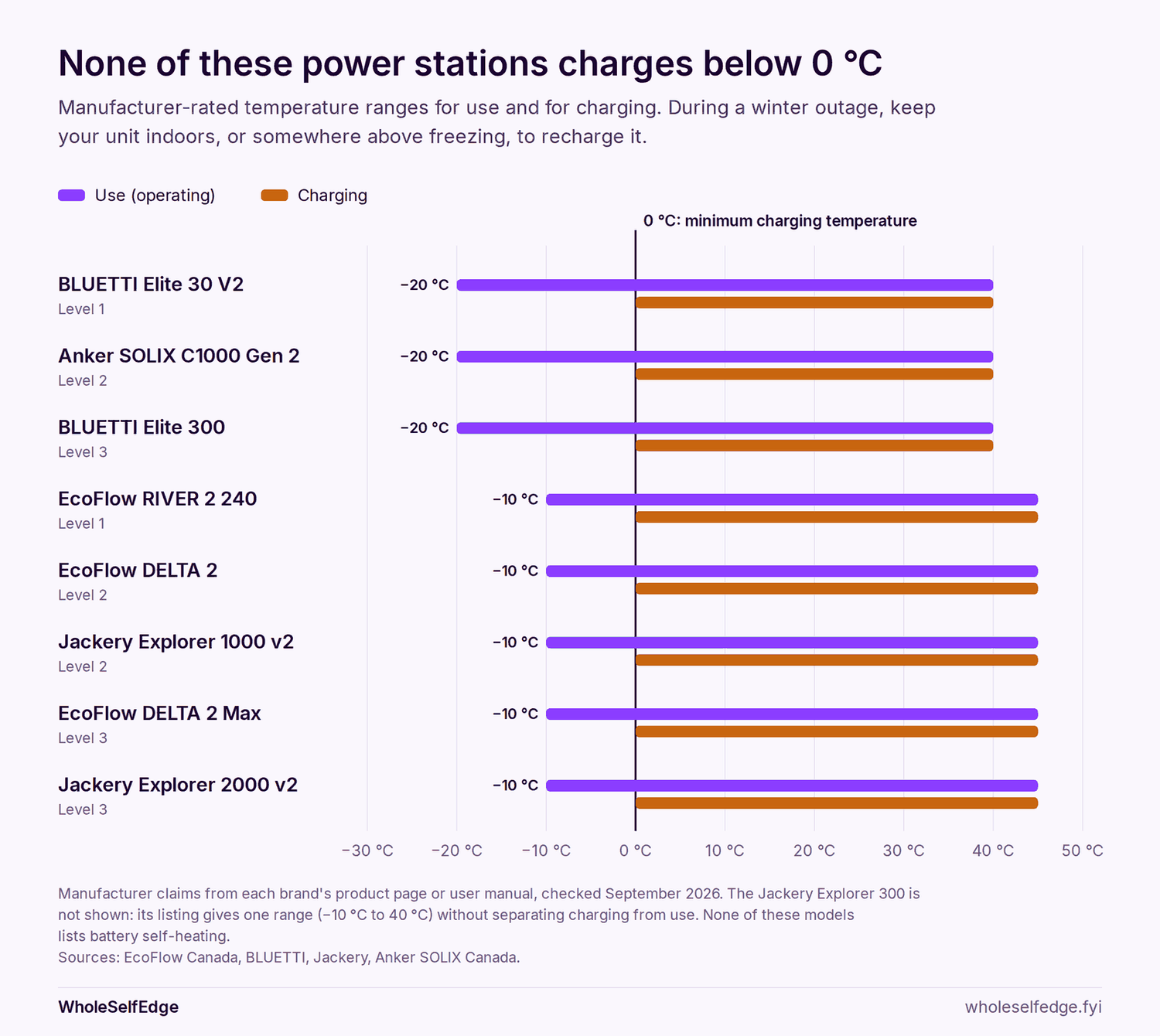
Charging in the cold: every model here whose specifications separate charging from use lists 0 °C as the lowest charging temperature, and none mentions battery self-heating. Store and recharge your unit indoors; most can still be used below freezing (down to −10 °C or −20 °C, depending on the model).
Recharge options: check whether a unit recharges from a wall outlet, a car outlet, and solar panels — during an extended outage, solar recharging may be the only option.
Recalls: our search found no Health Canada recalls for the models in this guide as of September 29, 2026. A related model, the EcoFlow DELTA Max 2000 (model EFD310, not the DELTA 2 Max above), was recalled in October 2025 for a risk of overheating and fire; the remedy is a free firmware update. Check Health Canada's recalls database before buying any power station, new or used.
Battery Power Stations vs. Fuel Generators
This guide covers battery-based portable power stations, not fuel-burning generators. That's a deliberate choice: according to Health Canada, fuel generators must never be used indoors, in a garage, or in a shed, and should be operated at least 6 metres (20 feet) from any building due to carbon monoxide poisoning risk — even models with automatic shut-off features. A battery power station carries no combustion or carbon monoxide risk and can be used safely indoors, which makes it a simpler and safer starting point for most households. We may cover fuel generators in a separate guide, with the safety precautions they require front and centre.
A Note on These Recommendations
The products above are candidates we identified through research, not products WholeSelfEdge has purchased. Specifications and availability should be re-verified at the time of purchase, since both change over time. As an Amazon Associate, WholeSelfEdge earns from qualifying purchases made through the affiliate links in this guide, at no additional cost to you — see our Terms & Affiliate Disclosure for details.
Sources
Government of Canada / Health Canada — Carbon monoxide: Preventing exposure
Health Canada — EcoFlow Delta Max 2000 power stations recall (October 24, 2025)
Amazon.ca — product listings for the units in this guide (our affiliate links point there; see each listing for the current price and customer reviews)
Outdoor Life — The Best Portable Power Stations of 2026 (January 9, 2026)
GearJunkie — The Best Portable Power Stations of 2026
OutdoorGearLab — Best Portable Power Stations (updated July 23, 2026)
StorageReview — EcoFlow DELTA 2 Max review (July 2023)
StorageReview — BLUETTI Elite 300 review (August 27, 2026)
BLUETTI — Elite 300 user manual (PDF)