Out of Cell Range: A Buyer's Guide to Satellite Communicators
Most of Canada has no cell coverage at all once you're off the highway — hiking, hunting, fishing, backcountry skiing, or just driving a rural road. A satellite communicator won't replace calling 911, but it can send an SOS, text home, or share your location when your phone shows zero bars.
Last updated: September 29, 2026
In our 72-Hour Emergency Checklist, we focused on staying safe at home during a disruption. This guide covers the opposite scenario: staying reachable when you're away from home, outside cell range, and something goes wrong. If you've already read our guide to backup power for winter outages, think of this as the portable, on-the-trail counterpart.
Affiliate disclosure: WholeSelfEdge participates in the Amazon.ca Associates Program. As an Amazon Associate, we earn from qualifying purchases. Some links in this guide are affiliate links: if you buy through them, we may earn a commission at no additional cost to you. This doesn't change which devices we include or what we say about them. Details in our Terms & Affiliate Disclosure.
How We Chose These
As with our other buyer's guides, we keep three types of information clearly separate: manufacturer specifications (battery life, water rating, operating temperature, network), taken from each brand's own spec pages and owner's manuals; independent professional testing, from outlets that put these devices through field or lab testing (cited by name below); and our own analysis of how each device fits Canadian conditions: cold, remote areas, and subscription costs. We don't reproduce Amazon prices or customer ratings on this page, because both change constantly; each product link takes you to the current listing on Amazon.ca.
How to read the price tiers: instead of listing device prices that can change several times a day, we group devices by relative cost within this guide: $ (lowest), $$ (mid-range), and $$$ (highest). Check the current price on Amazon.ca before buying. The subscription prices further down come from each manufacturer's Canadian website, not from Amazon.
Important: the device price is not the full cost. Every product in this guide requires a separate, paid monthly (or per-message) satellite subscription plan to actually send messages or trigger an SOS — more on that below, under “What to Look For.”
Top Picks
Top Pick — Garmin inReach Mini 2
Two-way satellite messaging over the Iridium network, plus GPS navigation and an SOS button monitored 24/7 by Garmin's emergency response centre (manufacturer claim)
Manufacturer specs: about 100 g (3.5 oz); IPX7 water rating (1 m for 30 min); up to 14 days of battery at 10-minute tracking with a full view of the sky, up to 4 days under moderate tree cover; operates from −20 °C to 60 °C, but only charges between 0 °C and 45 °C
Price tier: $$ · Check the current price on Amazon.ca
Independent testing: OutdoorGearLab scored it 82/100, calling on-device message composing “slow, laborious.” Outdoor Life named it “Best Ultralight” in its 2024 field test, but its messages always took slightly longer to send than the inReach Messenger's (up to 15 minutes longer in the worst case)
Why we picked it: it's the only device in our top picks with real GPS navigation built in, not just messaging. Worth knowing: GearJunkie's 2026 rankings list Garmin's newer inReach Mini 3 Plus instead of the Mini 2
Top Pick — ZOLEO Satellite Communicator
Two-way satellite messaging over Iridium, with automatic switching to cellular or Wi-Fi messaging when available, plus a Medical Assist feature (manufacturer claim)
Manufacturer specs (current ZOLEO 1500 model): 150 g (5.3 oz); IP68 (1.5 m for 30 min); MIL-STD-810G; about 200+ hours of battery with a message check every 12 minutes; operates from −20 °C to +55 °C; SOS operator: Global Rescue
Price tier: $ · Check the current price on Amazon.ca
Independent testing: GearJunkie names it “Best Budget” (6.7/10). OutdoorGearLab scored it 76/100, calling it “comprehensive, polished, two-way satellite communication at a fair price,” while noting its biggest limitation: you can't compose or read custom messages on the device itself. Every custom message goes through the paired smartphone app over Bluetooth
Why we picked it: it's in the lowest price tier of the two-way communicators here, and it can switch to cellular or Wi-Fi messaging whenever you're back in range, skipping the satellite network and its per-message costs
Alternatives
Price tier: $$ · Check the current price on Amazon.ca. GearJunkie named it “Best Overall” for 2026 (8.4/10), citing “exceptional battery life (up to 28 days)” and “the most consistent coverage” of any device they tested, with automatic switching between cellular and Iridium networks. OutdoorGearLab scored it 83/100 with its Best Buy award for two-way messaging, and Outdoor Life also named it “Best Overall” in its 2024 test. Manufacturer specs: IPX7; up to 28 days of battery at 10-minute tracking with a full sky view (up to 14 days under moderate tree cover); operates from −20 °C to 60 °C and charges between 0 °C and 45 °C. It has no mapping screen the way the Mini 2 does: it's built for messaging, not navigation.
Price tier: $ · Check the current price on Amazon.ca. The lowest-cost device here with dedicated SOS and location tracking, but it only sends preset, pre-written messages: there's no custom two-way texting like every other device in this guide, so treat it as a one-way safety net rather than a way to have a conversation with someone back home. It also runs on a different network, Globalstar rather than Iridium, with SOS coordination by FocusPoint International. SPOT lists Canada within its coverage area, while GearJunkie notes Globalstar has “little coverage in polar regions,” which matters for Canada's far north. Manufacturer specs: 142 g (5 oz) with lithium batteries; IP68; operates from −30 °C to +60 °C; runs on 4 replaceable AAA lithium batteries (SPOT rates one set for about 1,250 check-in and custom messages), an advantage when you can't recharge. Independent testing: OutdoorGearLab scored it 45/100, and in Outdoor Life's 2024 field test it missed a check-in while indicating the message had been sent.
Price tier: $$$ · Check the current price on Amazon.ca. OutdoorGearLab's Editors' Choice at 85/100, called “the premier choice for reliable wilderness communication”; GearJunkie names it “Best Splurge” (8.4/10). It adds photo and voice messages over satellite and supports longer messages than any other device here. Manufacturer specs: IPX7; up to 600 hours of battery in low-power mode at 10-minute tracking (up to 110 hours in performance mode), with a full sky view; operates from −10 °C to 60 °C, a narrower cold range than the other Garmin devices here (−20 °C), worth weighing for winter use. The clear step-up pick if you want to send more than text.
We also looked at three other devices in this category — the SPOT X, the ACR Bivy Stick, and the Motorola Defy Satellite Link — and left them out of the picks above, not because they're necessarily bad devices, but because we couldn't verify enough to recommend them with confidence right now: when we checked, the SPOT X wasn't sold directly by Amazon or SPOT on Amazon.ca (only third-party sellers), and in Outdoor Life's 2024 test it missed the same check-in as the SPOT Gen4; the ACR Bivy Stick had too little independent testing and buyer feedback for us to assess; and the Motorola Defy Satellite Link was sold by a third-party reseller rather than Amazon or Motorola directly. We may revisit any of these as more data becomes available.
What Can a Satellite Communicator Actually Do?
Every device above can, at minimum: trigger an SOS that's routed to a live emergency-response coordination centre (more below); send a check-in message to pre-set contacts; and share your GPS location, either on request or on an automatic tracking interval. Most (all except the SPOT Gen4) can also send and receive custom two-way text messages, either directly on the device or through a paired smartphone app.
What it can't do, on any device in this guide: make a voice call. These are text-and-location devices, not satellite phones — if you need to actually talk to someone, that's a different (and considerably more expensive) category of device, like the Iridium GO!, which we haven't evaluated here. Message delivery also isn't instant — it typically takes anywhere from under a minute to several minutes, depending on satellite visibility, and you generally need a relatively clear view of the sky for the device to connect at all; dense tree cover or a narrow canyon can delay or block a signal.
The subscription is the real ongoing cost. None of these devices work out of the box — each one requires an active satellite subscription plan, billed separately from the device itself:
ZOLEO, verified directly on zoleo.com/en-ca: Prepare at $24.99 CAD/month (50 satellite messages included, $0.50 CAD per message after that) or Protect at $44.99 CAD/month (unlimited satellite messages). Both plans carry a $24.99 CAD one-time activation fee and a 3-month minimum term.
Garmin inReach, verified directly on garmin.com/en-CA (four consumer tiers, all month-to-month, no minimum term shown on the plan page itself):
Enabled — $10.99/month: SOS messaging at no extra cost; everything else (texts, weather, tracking) billed pay-as-you-go
Essential — $24.99/month: 50 texts/weather requests per month, unlimited check-ins and reactions, pay-as-you-go tracking, 10 photo/voice messages
Standard — $39.99/month: 150 texts/weather requests per month, unlimited check-ins, reactions, and live tracking, 25 photo/voice messages
Premium — $69.99/month: Unlimited texts, check-ins, reactions, weather requests, and live tracking, 50 photo/voice messages
Garmin's plan page also mentions a separate one-time activation fee and a “Suspend” option (pause the plan for up to 12 months at no cost) — worth knowing before you commit; we didn't capture the exact activation fee amount in this pass.
Comparing the two brands on price alone: ZOLEO's cheapest plan ($24.99 CAD/month) lands right at Garmin's second tier (Essential, also $24.99 CAD/month) — but Garmin's Enabled plan undercuts both at $10.99 CAD/month if you're comfortable paying per message instead of a flat monthly allowance.
What to Look For, Regardless of Brand
Two-way vs. one-way messaging: the SPOT Gen4 only sends preset messages; every other device in this guide supports custom, two-way text.
On-device keyboard vs. phone-dependent messaging: the Garmin devices (Mini 2, Messenger, Messenger Plus) let you compose messages directly on the unit, even without a phone nearby. ZOLEO requires a paired smartphone via Bluetooth for any custom message — a real consideration if your phone is lost, dead, or damaged.
Subscription structure: check the monthly message allowance, per-message overage cost, minimum contract term, and cancellation policy before buying — these vary significantly and, over a year or two, can cost more than the device itself.
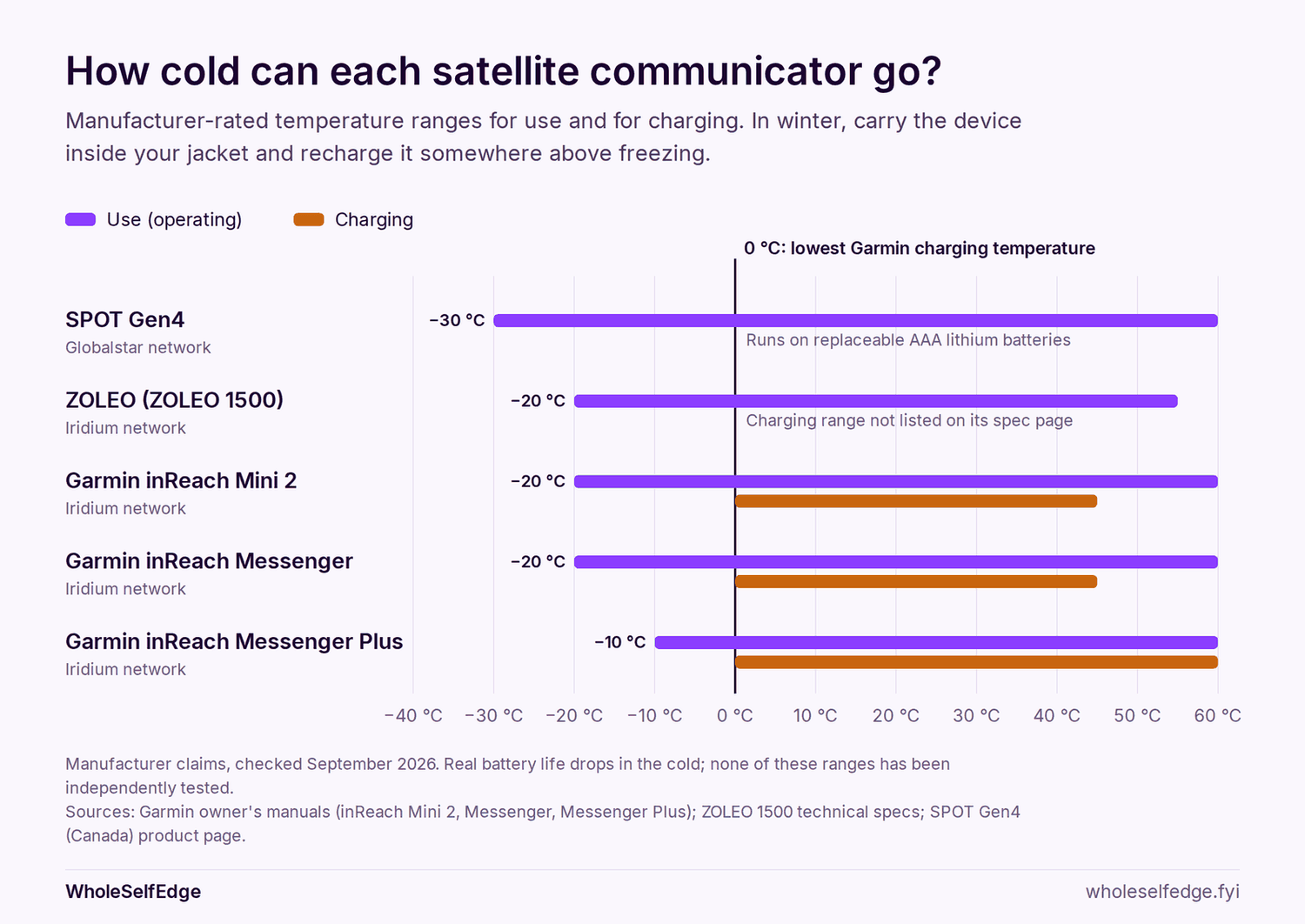
Cold-weather limits: rated operating ranges differ, from −30 °C (SPOT Gen4) and −20 °C (ZOLEO, inReach Mini 2, inReach Messenger) to −10 °C (inReach Messenger Plus), per each manufacturer. Garmin's manuals also list 0 °C as the minimum charging temperature, so in winter, keep the device and any power bank warm inside your jacket. The SPOT Gen4 is the only one here that runs on replaceable AAA lithium batteries instead of a built-in rechargeable one.
Who actually answers your SOS: Garmin inReach devices route SOS alerts to Garmin's own 24/7 emergency response centre (Garmin acquired GEOS, operator of the International Emergency Response Coordination Center, in 2021). ZOLEO's specification page for its current model lists Global Rescue as its SOS operator, and SPOT uses FocusPoint International. Check which service your device uses before you rely on it.
Satellite Communicators vs. Personal Locator Beacons (PLBs)
This guide covers two-way satellite communicators, not personal locator beacons (PLBs) like the ACR ResQLink. That's a meaningful distinction, not just a different price point: a PLB is a one-time purchase with no subscription and no recurring fee, registered for free with Public Safety Canada's National Search and Rescue Secretariat, and its distress signal is picked up by the international COSPAS-SARSAT satellite system and routed to the Canadian Mission Control Centre, which coordinates with military and civilian search-and-rescue teams directly. A PLB has no two-way texting, no check-in messages, and no tracking — it does exactly one thing, sending an SOS, and does it without an ongoing bill.
A satellite communicator trades that simplicity for a recurring subscription cost in exchange for two-way texting, routine check-ins, and location sharing — genuinely useful if you also want to tell people you're okay, not just call for help when you're not. Neither device replaces the other's core promise. If all you want is an emergency-only safety net with no recurring cost, a PLB may be the better fit; if you also want to text home from the trail, a satellite communicator is the only option that does that.
A Note on These Recommendations
The products above are candidates we identified through research, not products WholeSelfEdge has purchased or field-tested. Specifications, subscription costs, and availability should be re-verified at the time of purchase, since all of them change over time. As an Amazon Associate, WholeSelfEdge earns from qualifying purchases made through the affiliate links in this guide, at no additional cost to you — see our Terms & Affiliate Disclosure for details.
Sources
Amazon.ca: product listings for the devices in this guide (our affiliate links point there; see each listing for the current price and customer reviews)
OutdoorGearLab — Best Satellite Communicators (updated May 11, 2026): https://www.outdoorgearlab.com/topics/camping-and-hiking/best-personal-locator-beacon
OutdoorGearLab — Garmin inReach Mini 2 Review: https://www.outdoorgearlab.com/reviews/camping-and-hiking/personal-locator-beacon/garmin-inreach-mini-2
OutdoorGearLab — ZOLEO Satellite Communicator Review: https://www.outdoorgearlab.com/reviews/camping-and-hiking/personal-locator-beacon/zoleo-satellite-communicator
GearJunkie — The Best Satellite Messengers of 2026 (September 2, 2026): https://gearjunkie.com/technology/best-satellite-messengers
Outdoor Life — Best Satellite Messengers (field test, September 26, 2024): https://www.outdoorlife.com/gear/best-satellite-messengers/
Garmin — inReach Mini 2 Owner's Manual, specifications and battery life: https://www8.garmin.com/manuals/webhelp/GUID-802DEF62-EBB2-463C-8C51-C58FB29F89E3/EN-US/GUID-5D201E16-5AA1-4AB7-8BAA-9C5786B518FE.html
Garmin — inReach Messenger Owner's Manual, specifications: https://www8.garmin.com/manuals/webhelp/GUID-5919E4DF-BE2C-4897-AE03-3BF5B0AD3ACA/EN-US/GUID-5FBF9580-B962-4F0B-A639-F3E083117660.html
Garmin — inReach Messenger Plus Owner's Manual, specifications: https://www8.garmin.com/manuals/webhelp/GUID-A3665AAB-70E7-48F1-9582-988E09455E22/EN-US/GUID-DDDB2073-4CFA-4F89-BD4E-B1990EBDF5C5.html
ZOLEO — ZOLEO 1500 Features and Technical Specs: https://support.zoleo.com/hc/en-us/articles/50584737916820-ZOLEO-1500-Features-and-Technical-Specs
SPOT — SPOT Gen4 (Canada): https://www.findmespot.com/en-ca/products-services/spot-gen4
ZOLEO — Satellite Messaging Plans (Canada): https://www.zoleo.com/en-ca/plans
Garmin Newsroom — Garmin acquires GEOS International Emergency Response Coordination Center: https://www.garmin.com/en-US/newsroom/press-release/corporate/garmin-acquires-leading-provider-of-emergency-monitoring-and-response-services/
Garmin — inReach Consumer Plans (CAD, checked September 17, 2026): https://www.garmin.com/en-CA/p/837461/
Garmin — inReach Subscription Plan Options and Feature Information: https://support.garmin.com/en-CA/?faq=QK8DnECaKb0JVz1ep2zKI6
Public Safety Canada — 406 MHz Personal Locator Beacons: https://www.publicsafety.gc.ca/cnt/rsrcs/pblctns/prsnl-lctr-bcn-406-mhz-2022/index-en.aspx
Government of Canada — Canadian Mission Control Centre: https://www.canada.ca/en/air-force/services/search-rescue/canadian-mission-control-centre.html