Bug-Out Bag / EDC Emergency Backpack: A Buyer's Guide
Choosing a 72-hour bag comes down to three questions: how much capacity you actually need, whether a tactical-styled pack or a plain hiking pack fits how you'll use it, and how much weight you can realistically carry. This guide compares five bags across that range rather than naming a single "best" one, because the right choice depends on those answers, not on a universal winner.
Last updated: September 30, 2026
Our 72-Hour Emergency Checklist focuses on staying safe at home during a disruption. This guide covers the other half of that plan: the bag you'd grab if you had to leave. For the communication and power layers of a portable kit, see our guides to satellite communicators and backup power for winter outages.
How We Chose These
As with our other buyer's guides, we keep three types of information clearly separate: manufacturer specifications (capacity, weight, fabric, frame, features, warranty), taken from each brand's own product and warranty pages; independent testing, from outlets that carried these packs themselves (cited by name below, with the version they tested); and our own analysis of how each bag fits a 72-hour kit. We don't reproduce Amazon prices or customer ratings on this page, because both change constantly; each product link takes you to the current listing on Amazon.ca.
How to read the price tiers: instead of listing prices that change often, we group bags by relative cost within this guide: $ (lowest), $$ (mid-range), and $$$ (highest). Check the current price on Amazon.ca before buying.
Selection Criteria
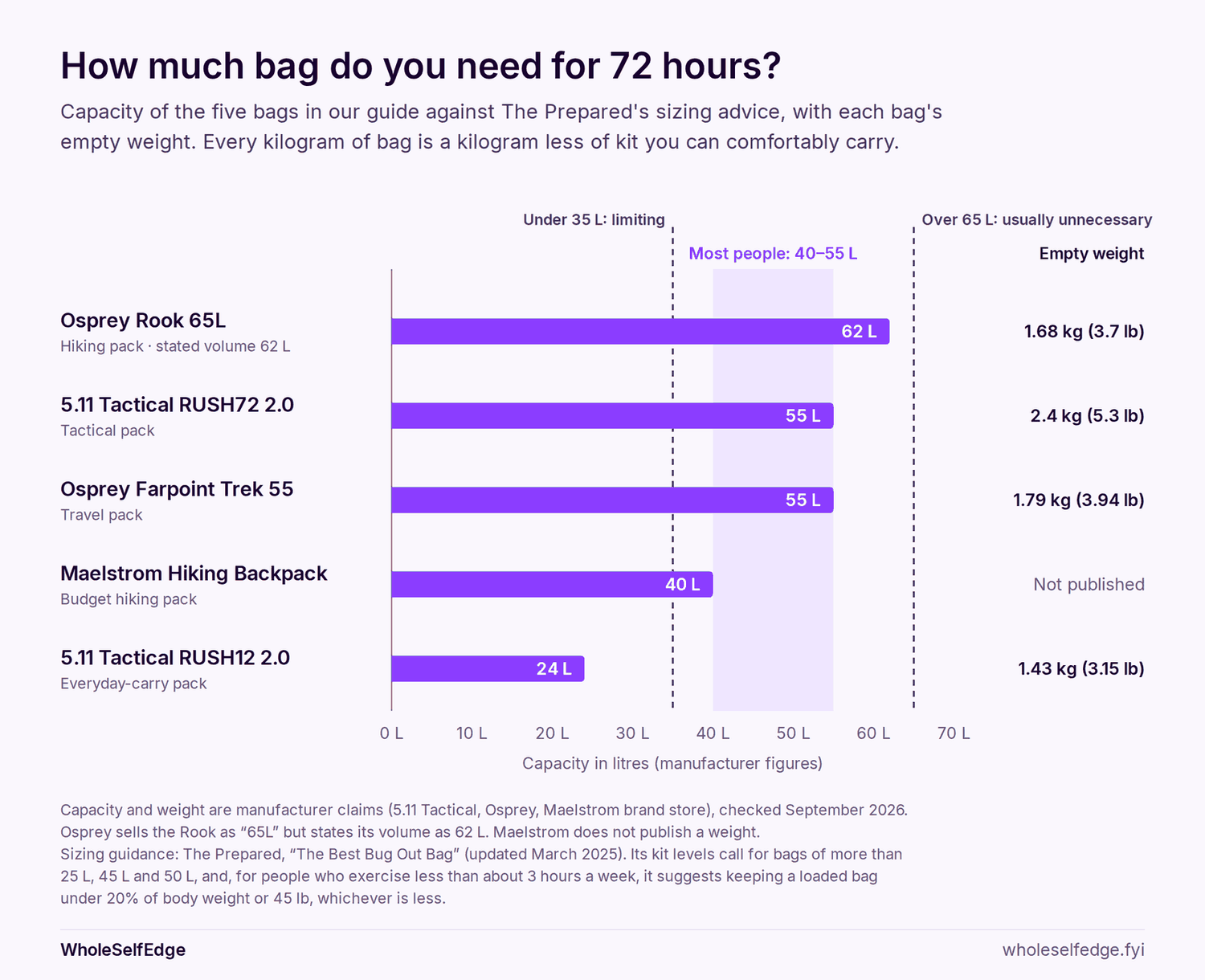
- Capacity for the kit you'll carry. The Prepared's bug-out bag guide finds that most people end up with a 40–55 L bag, calls anything over 65 L unnecessary and anything under 35 L limiting, and sets minimums of more than 25 L, 45 L, and 50 L for its three kit levels.
- Carrying comfort. A hip belt matters on any bag over about 30–35 L (The Prepared), and a frame helps once the load gets heavy.
- Durability and weather. Fabric weight, water-repellent treatment, and whether a rain cover is included. The Prepared puts the "sweet spot" at roughly 500–600D fabric.
- Look. A heavily tactical design (lots of MOLLE webbing, military styling) draws attention; a plain hiking or travel pack is more discreet.
- Warranty and independent evidence. We favoured bags backed by a clear manufacturer warranty and by at least one independent hands-on review, and we say so when a bag has neither.
The Five Bags Compared
| Bag | Capacity | Weight (manufacturer) | Price tier | Independent testing found | Best for |
|---|---|---|---|---|---|
| Maelstrom Hiking Backpack | 40 L | Not published | $ | None found | Lowest-cost starter bag |
| 5.11 Tactical RUSH12 2.0 | 24 L | 1.43 kg (3.15 lb) | $$ | Pack Hacker, Garage Gym Revisited | Everyday carry / secondary bag |
| 5.11 Tactical RUSH72 2.0 | 55 L | 2.4 kg | $$$ | Long-term reviews, mostly of the original RUSH72 | Modular tactical kit |
| Osprey Farpoint Trek 55 | 55 L | 1.79 kg (3.94 lb) | $$$ | Treeline Review (sister model), Indie Traveller | Travel pack that doubles as a go-bag |
| Osprey Rook 65L | 62 L stated volume | 1.68 kg (3.7 lb) | $$$ | OutdoorGearLab (72/100), Switchback Travel | Largest, low-profile hiking pack |
Weights and capacities are manufacturer figures from each brand's product page, checked September 30, 2026. Osprey sells the Rook 65L under that name but lists its volume as 62 L.
Maelstrom Hiking Backpack (40L)
Manufacturer specs (brand store page): 210D rip-stop nylon described as water- and tear-resistant; included rain cover; a waterproof "wet pocket" inside the main compartment; hydration-bladder holder with a hose port; chest buckle with a built-in whistle; reflective markings; two zippered hip-belt pockets and two mesh side pockets. The brand does not publish the pack's weight or dimensions.
Warranty: 2 years from purchase for the original buyer, excluding normal wear and misuse. The terms say coverage applies "within the region where the product was purchased" and don't specify how Amazon.ca purchases are handled, so confirm with the seller.
Independent testing: we didn't find a hands-on review of this pack from an established outdoor or preparedness publication.
Best use case: someone who wants a real 40 L bag with a hip belt and rain cover to start packing today, at the lowest cost in this guide.
Limitations / reasons not to buy: it's a generic hiking pack, not purpose-built for emergency use. Its 210D fabric is much lighter than the 500–600D that The Prepared recommends, and with no published weight, no independent test, and limited information about who stands behind the warranty, we can't speak to how it holds up under a full 72-hour load. If durability matters more than price, look at the other bags here.
Check the current price on Amazon.ca5.11 Tactical RUSH12 2.0 (24L)
Manufacturer specs (5.11 Tactical): 24 L; 1.43 kg (3.15 lb); water-repellent 1050D nylon; MOLLE webbing on the front, sides, and shoulder straps; rear hydration compartment; padded sleeve for laptops up to 15"; a hidden compartment; fleece-lined eyewear pocket.
Warranty: 5.11 warrants its products against defects in materials and workmanship for as long as the original purchaser owns them, excluding abuse and extended wear and tear.
Independent testing: Pack Hacker carried it for two weeks and scored it 7.5/10, finding the harness comfortable and easy to adjust, but the PALS webbing more than most people need and the laptop sleeve awkward to reach (October 2023). Garage Gym Revisited used it for about five to six months, mainly for rucking, and rated it 85/100, citing durable fabric, YKK zippers, and plenty of compartments, against no frame sheet and thin laptop padding (September 2024). The Prepared lists the RUSH12 2.0 as its budget pick.
Best use case: a compact, tough bag for daily carry, a vehicle kit, or a second bag alongside a larger pack.
Limitations / reasons not to buy: at 24 L it sits just under The Prepared's smallest kit level (more than 25 L), so it won't hold a complete layered 72-hour kit on its own. It has no frame sheet, and its military styling is conspicuous if you want to blend in.
Check the current price on Amazon.ca5.11 Tactical RUSH72 2.0 (55L)
Manufacturer specs (5.11 Tactical): 55 L; 2.4 kg; water-repellent 1050D nylon; MOLLE webbing on the front, sides, and shoulder straps; hydration compartment for a 3 L reservoir; padded sleeve for laptops up to 15"; aluminum stay in the back panel; waist strap; a hidden compartment.
Warranty: the same 5.11 coverage as the RUSH12: defects in materials and workmanship for as long as the original purchaser owns it, excluding abuse and extended wear and tear.
Independent testing: most long-term reviews cover the original RUSH72, not the 2.0. The Firearm Blog reported strong durability after five years with the original and also looked at the 2.0; the reviewer noted the bag is stiff at first and needs breaking in (July 2023). OutdoorHub's ten-year review of an original found the straps spread weight well and the organization practical, but flagged the military look as a drawback for low-profile carry (June 2023). The Prepared lists the RUSH72 2.0 among its mid-tier picks.
Best use case: someone building a complete, purpose-built 72-hour kit who wants MOLLE attachment points for modular pouches and a very tough shell.
Limitations / reasons not to buy: the heaviest bag here before anything goes in it (2.4 kg), and the most conspicuous. Independent evidence for the current 2.0 version specifically is thin. Some reviews describe the RUSH72 as airline carry-on compatible; its main compartment alone is 23" tall, which is over Air Canada's 55 cm carry-on limit, so don't count on that.
Check the current price on Amazon.caOsprey Farpoint Trek 55
Manufacturer specs (Osprey): 55 L; 1.79 kg (3.94 lb); 74 × 36 × 38 cm; recycled 210D high-tenacity nylon with a PFAS-free water-repellent finish and a 420D base; stowable AirCover that works as a rain cover or a checked-bag cover; front-panel (suitcase-style) access to the main compartment; a sleeve for a hydration reservoir or a tablet/laptop; two hip-belt pockets; internal and external compression straps; AirSpeed suspension.
Warranty: Osprey's All Mighty Guarantee: Osprey repairs any damage or defect free of charge, or replaces the pack if it can't be repaired. It excludes cosmetic wear, loss or theft, and fit preferences; you pay shipping to Osprey, and repairs take several weeks.
Independent testing: Treeline Review tested the Fairview Trek 55, the women's-fit version of the same design, for a year of travel (July 2026): comfortable under heavy loads and easy to pack thanks to the clamshell opening, with price and weight as the main downsides. Indie Traveller hiked with what is likely an earlier generation on days of up to 25 km and recommended it (updated May 2025). The OutdoorGearLab and Pack Hacker reviews you may find cover the regular Farpoint 55, a different, carry-on-oriented pack.
Best use case: someone who wants one bag for long trips that can also serve as a go-bag, and values opening it like a suitcase.
Limitations / reasons not to buy: at 74 cm tall it is not a carry-on bag. Its main fabric (210D high-tenacity nylon) is lighter than the 500–600D The Prepared recommends, though Osprey's repair guarantee offsets some of that risk. Unlike the regular Farpoint 55, it has no detachable daypack. The Amazon.ca listing groups several sizes, so confirm that 55 L is selected before buying.
Check the current price on Amazon.caOsprey Rook 65L
Manufacturer specs (Osprey): sold as the "Rook 65L", with a stated volume of 62 L; 1.68 kg (3.7 lb); recycled 600D polyester with a PFAS-free water-repellent finish; LightWire peripheral frame; AirSpeed suspended-mesh back panel; about 10 cm (4 in) of torso adjustment; built-in removable rain cover; internal hydration sleeve; zippered sleeping-bag compartment. An Extended Fit version exists for longer torsos.
Warranty: Osprey's All Mighty Guarantee (see the Farpoint Trek above).
Independent testing: OutdoorGearLab tested it in Colorado and scored it 72/100, 11th of 13 backpacking packs, describing it as offering the basic features of a backpacking pack at an affordable price, with a comfortable mesh back, but heavy for its class and short on extras such as an external stretch pocket (January 2026). Switchback Travel carried it on a four-day Grand Canyon trip and called it durable for the price, though its padding felt stiff under a heavy load (review undated; likely an earlier version).
Best use case: the reader who wants the most room in this guide in a plain, internal-frame hiking pack that doesn't look tactical, with a rain cover already built in.
Limitations / reasons not to buy: it's a top-loading backpacking pack, so reaching items at the bottom is slower than with a clamshell design, and it has no MOLLE webbing; Osprey doesn't list a laptop sleeve. At 62 L it's near The Prepared's upper limit, and a bag this size is easy to overfill: plan the weight, not just the volume (see below).
Check the current price on Amazon.caHow Heavy Should a Packed Bag Be?
Volume is only half the question. The Prepared suggests that if you exercise less than about three hours a week, you keep a loaded bag under 20% of your body weight or 45 lb (about 20 kg), whichever is less, and test it with a one-mile walk. The empty weight of the bag counts toward that limit: the RUSH72 2.0 starts at 2.4 kg before anything goes in it, while the Rook 65L starts at 1.68 kg.
Alternatives Within This Guide
If budget is the deciding factor, the Maelstrom is the only bag in the lowest price tier, but it's also the one with the least verifiable information. For a compact, rugged daily bag, the RUSH12 2.0 is the only 24 L option. If MOLLE modularity matters most, the RUSH72 2.0 is the only 55 L bag built for it. If you'd rather not look tactical, the two Osprey packs are the more discreet choices: the Farpoint Trek if you also travel, the Rook 65L if you want the most capacity and a traditional hiking frame. No single bag here is the cheapest, lightest, and most thoroughly tested at once, and we're not presenting one as if it were.
What This Guide Doesn't Cover
This guide doesn't include an ultralight backpacking pack or a purpose-built "gray man" bag designed to look like ordinary luggage. Osprey sells women's-fit versions of some of its packs (for example, the Fairview Trek), which we haven't compared here.
Building the Full Kit
A backpack is the container, not the kit. To decide what goes inside, start with our 72-Hour Emergency Checklist. For the layers that matter most once you're away from home, see Out of Cell Range: A Buyer's Guide to Satellite Communicators and Backup Power for Canadian Winters.
A Note on These Recommendations
The products above are candidates we identified through research, not products WholeSelfEdge has purchased or field-tested. Specifications, warranty terms, and availability should be re-verified at the time of purchase, since all of them change over time. As an Amazon Associate, WholeSelfEdge earns from qualifying purchases made through the affiliate links in this guide, at no additional cost to you — see our Terms & Affiliate Disclosure for details.
Sources
- Amazon.ca: product listings for the bags in this guide (our affiliate links point there; see each listing for the current price and customer reviews).
- The Prepared — The Best Bug Out Bag (updated March 26, 2025): theprepared.com/bug-out-bags/reviews/best-bug-out-bag-backpack/
- Maelstrom — Hiking Backpack 40L product page and warranty terms: maelstromdirect.com, warranty page
- 5.11 Tactical — RUSH12 2.0 and RUSH72 2.0 product pages and warranty: RUSH12 2.0, RUSH72 2.0, warranty
- Osprey — Farpoint Trek 55, Rook 65L, and All Mighty Guarantee: Farpoint Trek 55, Rook 65L, All Mighty Guarantee
- Pack Hacker — 5.11 Tactical Rush12 2.0 Backpack 24L Review (October 26, 2023): packhacker.com
- Garage Gym Revisited — 5.11 Tactical RUSH 12 2.0 (24L) Backpack review (September 30, 2024): garagegymrevisited.com
- The Firearm Blog — 5.11 Rush 72 Backpack 5 Years Later (July 25, 2023): thefirearmblog.com
- OutdoorHub — 5.11 Rush 72 Backpack 10 Year Review (June 2, 2023): outdoorhub.com
- Treeline Review — Osprey Fairview Trek 55 Travel Pack Review (July 29, 2026): treelinereview.com
- Indie Traveller — Osprey Farpoint / Fairview 55 Trek Review (updated May 26, 2025): indietraveller.co
- OutdoorGearLab — Osprey Rook 65L Review (January 13, 2026): outdoorgearlab.com
- Switchback Travel — Osprey Rook 65 Backpacking Pack Review: switchbacktravel.com
- Air Canada — Carry-on baggage size limits: aircanada.com